

Flexible packaging had no quiet stretch in 2026. PP and PE drifted sideways through the first half, then turned sharply up in Q4. The EU Packaging and Packaging Waste Regulation (PPWR) became applicable in August, turning "recyclable" from a selling point into a mandatory field. And in China, new capacity kept coming online while utilization fell. Three forces pressing at once mean 2027 will not be a recovery year - it will be a structural shakeout.
1. Raw materials: the story isn't the price, it's certainty
BOPP thick gloss film is the most basic substrate in flexible packaging, and its price tracks the tug-of-war between PP cost and converter margins almost in real time. East China's mainstream tradable price was about CNY 10,850/t on 23 September 2026; by 2 November it had climbed to CNY 12,600–12,950/t, another CNY 225/t above end-October (SCI99). That is 16–19% in six weeks.
Upstream is more direct still: PP resin spot stood at CNY 11,083/t on 27 October, up 12.14% in a single month (Tonghuashun iFinD). The cause is supply: drawing-grade PP's share of output has run below its 2025 average since April, hitting a multi-year low of 17.96% in mid-June.
| Input | Reference level, 2026 | Movement | Date / source |
|---|---|---|---|
| PP resin | CNY 11,083/t | +12.14% m/m | 27 Oct 2026, Tonghuashun iFinD |
| BOPP thick gloss film (East China) | CNY 12,600–12,950/t | +CNY 225/t vs end-Oct | 2 Nov 2026, SCI99 |
| PE (East China) | CNY 9,150–9,650/t | Range-bound, drifting up | Sep–Oct 2026, market reports |
| PET bottle chip | CNY 7,300–7,700/t | Tracking crude and PTA | Aug 2026, spot quotes |
| LME aluminium (cash) | USD 3,015–3,254/t | Late-Sept high, easing in Oct | Sep–Oct 2026, LME |
More important than the size of the move is that the way prices form has changed. For two years the pattern was weak demand, falling resin and converters competing away their margin; in Q4 2026 it became supply contraction, rigid costs and film makers holding price. SCI99 expects seasonal demand to soften but prices to stay high and sticky, so a return to 2025 cost levels in H1 2027 is unlikely. The buyer's risk is no longer "paying too much" but "not securing volume, and getting bumped in the schedule."
2. Demand: behind the 4.26% CAGR, the mix is shifting
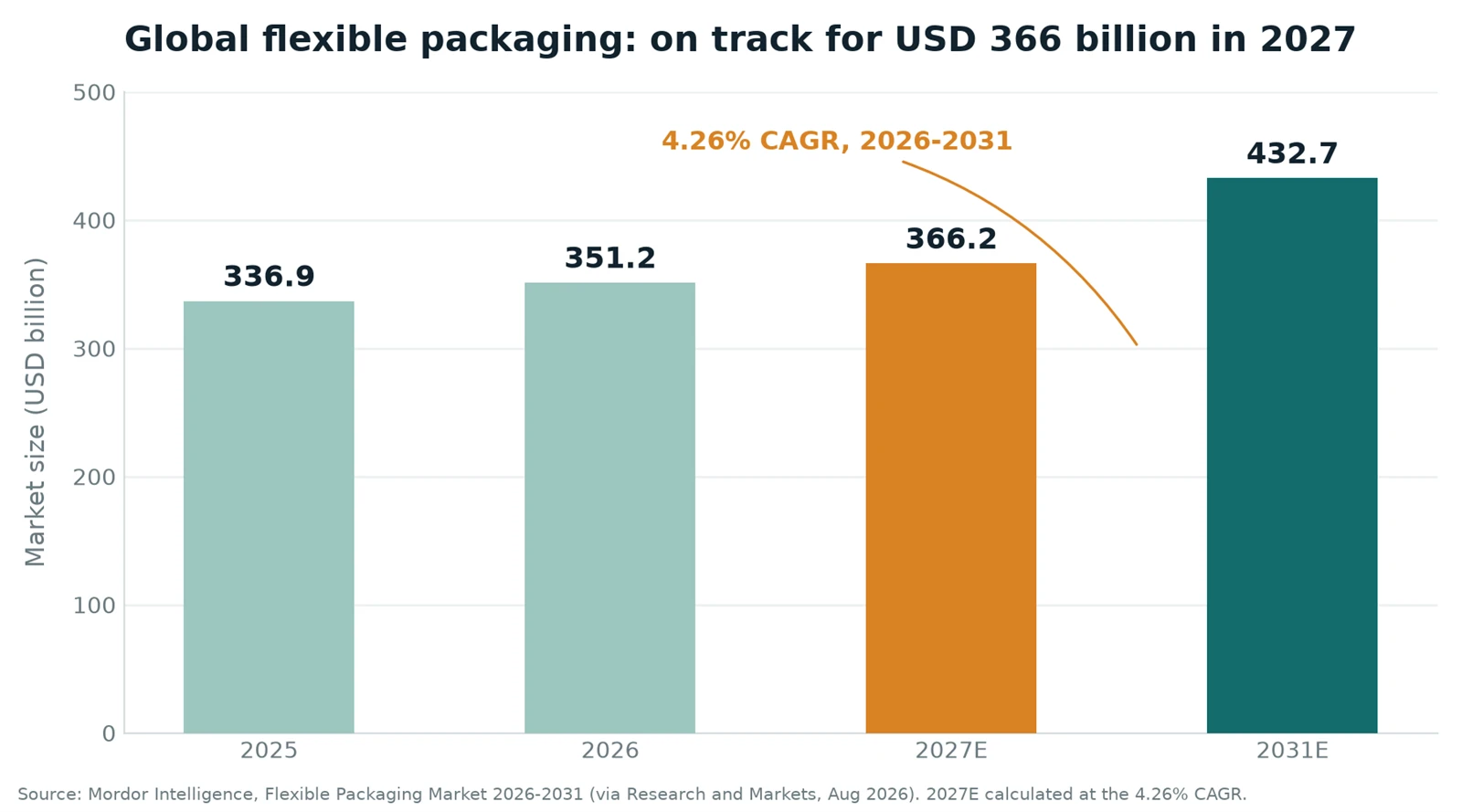
The global flexible packaging market was USD 336.87 billion in 2025, an estimated USD 351.22 billion in 2026, and is forecast to reach USD 432.74 billion by 2031 - a 4.26% CAGR over 2026–2031 (Mordor Intelligence, August 2026). On that trajectory, 2027 lands at about USD 366 billion.
4.26% is not dramatic, but it sits on three structural shifts. Asia-Pacific held 44.70% of the 2025 market and remains the engine. Pouches generated 46.05% of revenue and are roughly 70% lighter than glass jars, which maps onto freight and carbon budgets. And films and wraps lead all formats at a 5.61% CAGR - downgauging while raising puncture resistance is the most practical hedge against resin inflation.
China's numbers are equally concrete: about CNY 420 billion in 2025, up 6.8%, and expected to exceed CNY 450 billion in 2026. Exports are cooling, however - about USD 18.0 billion in 2025, forecast to edge up only to USD 18.5 billion in 2026, 2.7% growth, with order fragmentation clearly visible (Industry World, October 2026).
So volume grows modestly, and the increment concentrates in light, thin, mono-material and high-barrier. Converters still anchored in commodity laminates will feel the market growing while their order book is not.
3. Regulation: in 2027, compliance becomes a licence to operate
The EU's Packaging and Packaging Waste Regulation (EU) 2025/40 has applied since 12 August 2026 - the biggest overhaul of European packaging law in a decade. Recyclability-by-design and declaration-of-conformity duties started with application; 12 February 2027 brings the second wave, including reuse systems for takeaway containers and national penalty regimes; and by 2030 all packaging must be recyclable or compostable, with 35% recycled content in plastic packaging.
The direct consequence is that the compliance cost of multilayer laminates rises. PET/AL/PE and PA/PE perform well but are hard to close-loop in sorting and recycling. Substitution routes are clear: MDO-PE and PP-based mono-material, metallized or oxide-coated alternatives to foil, EVOH microlayer coextrusion and paper-based laminates.
China is moving in parallel: recyclable-design-compliant packaging should pass 40% coverage in mainstream retail channels in 2026, while PP-based monolayer barrier film climbs from 18% of the mix in 2025 to 25% in 2026 - not out of sentiment, but because export orders now write "recyclable design" into supplier audits.
4. Three calls for 2027
Call one: mono-material moves from sampling project to standard specification. Most plants were still running pilots in 2026; in 2027 EU brand owners will specify recyclable structures by default. The window is in matching seal strength, heat-seal window and puncture resistance to multilayer performance. Fail that, and you compete on price in commodity film.
Call two: pricing shifts from fixed quotes to resin-linked contracts. When resin moves more than 10% in a month, quarterly fixed pricing is a bet for both sides. Linking substrate price to a published index while fixing the conversion fee gives the buyer cost transparency and the converter a manufacturing margin - instead of a position on resin direction.
Call three: divergence accelerates; share concentrates at the top. Average utilization was about 78% in 2025 and is expected to slip to 75% in 2026, while the top ten players hold roughly 22% of the market, up 1.5 points year on year. Commodity film capacity keeps exiting; converters with vertical integration, compliance documentation and digital scheduling take the incremental volume.
5. What to do about it
Buyers and brands: lock H1 2027 substrate volume, priced with a linkage clause rather than a bet on a fall; request a recyclability assessment and PFAS declaration at design stage, not at PO stage; keep one mono-material fallback qualified.
Converters: downgauging and mono-material cut cost and compliance burden at once - spend the capital on register accuracy and tension control; move "we'll renegotiate when resin rises" into the contract; prepare conformity declarations, recycled-content traceability and carbon footprint data before a tender asks.
Exporters: South-East Asia, the Middle East and Africa remain the main flows and are more price-sensitive, which makes thin mono-material structures the most visible proposition; for EU orders, price compliance cost upfront rather than discovering it after a rejection.
6. FAQ
How big is the flexible packaging market in 2027? About USD 366 billion, calculated from Mordor Intelligence's August 2026 forecast of USD 351.22 billion in 2026 and a 4.26% CAGR to USD 432.74 billion by 2031.
Will flexible packaging get more expensive in 2027? Substrates are likelier to stay high and range-bound than to rise one-way: BOPP and PP already gained 12–19% in Q4 2026, leaving limited downside in H1 2027, while conversion fees face pressure as utilization falls to 75%. Increases will show up mainly as mix upgrade.
What does PPWR require? Recyclable-by-design (all packaging recyclable or compostable by 2030), 35% recycled content in plastic packaging by 2030, and duties on reuse, labelling and conformity declarations. 12 February 2027 is the second key date.
Can mono-material replace foil laminates? For short and medium shelf life - snacks, personal care, dry goods - yes. For long shelf life and high oxygen barrier (coffee, some meat), metallized, oxide-coated or EVOH microlayer builds are still needed. 2027 is not full substitution but structure selection by category.