

Current evidence does not establish that a global financial crisis will occur in 2027. The IMF's October 2026 World Economic Outlook projects global growth of 3.4% in 2027, following 3.1% in 2026. Its baseline therefore anticipates continued expansion, The challenge for the flexible packaging industry is to prepare for weaker conditions without treating a crisis as inevitable. Comparing today's vulnerabilities with 2008 helps explain what businesses should watch-and how they can respond.
What caused the 2008 financial crisis?
The 2008 crisis developed from weaknesses in mortgage lending and the wider financial system.
Expanding credit and rising US house prices encouraged increasingly risky borrowing. Mortgages were packaged into securities distributed across financial institutions. When housing prices declined and mortgage defaults increased, investors struggled to assess the value of those assets. federalreservehistory.org
The damage spread because financial institutions relied heavily on leverage and short-term funding. Falling confidence disrupted funding markets, forced asset sales and reduced lending. The Federal Reserve's historical analysis emphasizes that financial vulnerabilities amplified the initial losses into a broader systemic crisis. Federal Reserve Board
For businesses, the consequences extended beyond financial markets: customers reduced purchases, banks tightened credit and international trade weakened. Packaging companies faced a combination of lower orders, inventory adjustments and pressure on cash flow.

Is the situation before 2027 similar to 2008?
There are similarities, particularly concerns about leverage, asset valuations and confidence. However, the potential sources of stress are different.
The IMF's October 2026 Global Financial Stability Report identifies risks involving an AI-related market correction, sharp increases in sovereign bond yields and cyber threats. It also highlights vulnerabilities involving private credit and liquidity mismatches among institutional investors. imf.org
| Issue | 2008 crisis | Risks approaching 2027 |
|---|---|---|
| Potential starting point | US housing and mortgage losses | Asset repricing, government borrowing costs or operational disruption |
| Amplification mechanism | Leverage, opaque exposures and funding withdrawals | Leverage, concentrated investments and financial interconnections |
| Banking conditions | Severe stress at major institutions | Broad resilience, with vulnerable institutions remaining |
| Business concern | Credit contraction and collapsing confidence | Financing pressure, uncertain demand and possible disruption |
The comparison does not mean these risks will produce another 2008. A market correction becomes particularly dangerous when it damages credit availability, payment systems and confidence across multiple sectors.
What warning signs should packaging businesses monitor?
Stock prices alone provide an incomplete picture. Packaging companies should also track customer payment behavior, financing conditions and actual order patterns.

Useful warning signs include increasing overdue invoices, cancelled launches, smaller repeat orders and customers requesting substantially longer payment terms. A rise in quotation requests without corresponding purchase orders can also indicate cautious buying.
PMMI's 2026–2027 Economic Outlook describes slower, uneven expansion and persistent cost pressures, including margin pressure despite revenue growth. This supports careful operational planning rather than assuming that higher sales automatically mean stronger financial health. PMMI Business Intelligence
For exporters, customer-level information can be more actionable than a dramatic economic headline. A distributor delaying payment deserves attention even while national economic indicators remain positive.
How would a financial crisis affect the packaging industry?
The first impact would likely be uneven demand.
Packaging tied to essential consumption generally has stronger underlying support than packaging for discretionary products. McKinsey's historical review found that food and beverage packaging was more resilient during the financial crisis, while industrial and luxury-goods packaging was more sensitive. McKinsey
However, resilience does not guarantee stable profits. Customers may switch to cheaper products, reduce packaging complexity or demand price concessions.
The following are potential business responses under a downturn scenario, rather than measured forecasts:
| Packaging application | Possible demand response | Supplier priority |
|---|---|---|
| Everyday food and household products | Continued consumption with stronger price sensitivity | Consistent quality and cost-efficient formats |
| Coffee, snacks and pet food | Trading down or changes in pack size | Flexible specifications and replenishment options |
| Luxury and discretionary products | Delayed launches and reduced volumes | Smaller commitments and inventory control |
| Healthcare and hygiene | Support from essential uses, varying by product | Documentation and application suitability |
Would flexible packaging perform better than other formats?
Flexible packaging could remain attractive where it delivers a measurable cost or functional advantage.
Pouches and roll stock can offer low packaging weight, compact storage and efficient transport. Resealable formats may support repeated use, while suitable barrier structures help protect products against moisture or oxygen.
These benefits must be assessed application by application. A pouch that reduces material cost but causes filling problems or product spoilage offers little economic value.
During a downturn, purchasing discussions are likely to focus increasingly on total cost: packaging consumption, line efficiency, transport, damage and product losses. Suppliers that demonstrate these outcomes will have a stronger proposition than those competing only on unit price.

Would a crisis make plastic raw materials cheaper?
A demand-driven downturn could reduce consumption of oil, petrochemical feedstocks and packaging materials, creating downward pressure on some prices.
Yet this is only one possible pathway. An energy supply disruption could raise production costs while consumer demand weakens. Plant closures, maintenance and reduced operating rates could also restrict the availability of particular film grades.
Finished pouch prices would not necessarily move at the same speed as commodity benchmarks. Previously purchased materials, printing, adhesives, conversion and logistics all influence quotations.
Buyers should therefore compare equivalent specifications and delivery periods. Neither "prices will keep rising" nor "a recession will make everything cheaper" provides a reliable procurement strategy.
How could international conditions affect packaging trade?
Trade tensions, exchange rates and transport disruption could amplify financial pressure.
An importer may face higher landed costs even when a Chinese supplier's factory price remains unchanged. Currency movements, tariffs, financing charges and delivery delays can all change the economics of an order.
The IMF's economic outlook identifies renewed trade tensions and conflict escalation among the downside risks to global growth. imf.org
For flexible packaging exporters, the practical response is customer and market diversification, clear quotation terms and disciplined credit assessment. For overseas buyers, qualifying alternative supply before disruption occurs can improve continuity.
What should businesses do before 2027?
Preparation should protect liquidity and essential supply.
Review demand by customer and product rather than applying one growth assumption across the business. Separate confirmed orders from optimistic forecasts, and purchase custom printed inventory accordingly.
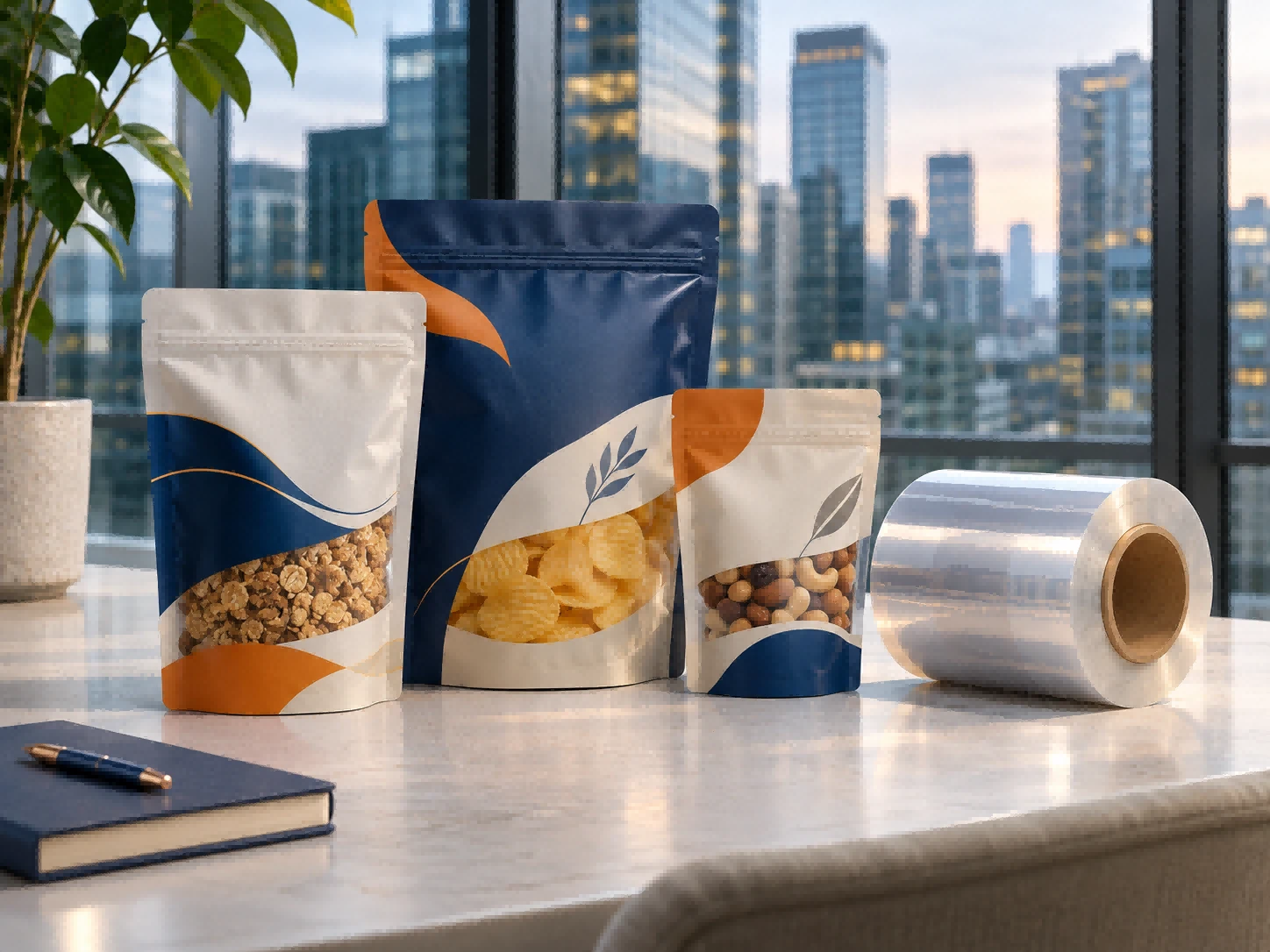
Use staged purchasing where practical. Stable, frequently reordered designs may justify planned production, while uncertain launches need smaller commitments.
Maintain a rolling cash-flow forecast and monitor receivables closely. Agree on material specifications, inspection requirements and payment milestones before production.
China-based HongBang Packaging operates in the custom flexible packaging sector, offering stand-up and flat-bottom pouches, high-barrier bags, retort pouches, spout pouches and printed roll film for varied applications.
What is the flexible packaging outlook for 2027?
A global financial crisis is a risk scenario, not an established forecast.
Under continued expansion, flexible packaging demand could develop unevenly, with buyers emphasizing value and dependable supply. Under a downturn, essential applications may offer relative support while competition and payment risks intensify. Under a supply shock, weak demand could coexist with higher costs.
Across these scenarios, the strongest business priorities remain consistent: suitable materials, efficient production, controlled inventory and healthy cash flow.
The lesson from 2008 is to understand how financial stress reaches customers and operations. Flexible packaging companies that prepare early and respond to verified demand will be better positioned to protect margins and serve customers through uncertainty.