


For food brands, coffee roasters, pet food companies and packaging importers, controlling flexible packaging costs has become more complicated than negotiating a lower price per pouch.
Crude oil, plastic resin availability, ocean freight and international trade relations all influence the final cost of custom printed packaging. These factors can move in different directions: oil may fall while film suppliers continue using expensive inventory, and container freight may soften while delivery reliability deteriorates.
As November 2026 unfolds, buyers face an important question: should they purchase packaging early or wait for lower prices?
The strongest approach is to secure essential demand while retaining flexibility for future purchases.
Are plastic packaging raw material prices still rising?
Recent increases have created genuine cost pressure, but the market is becoming more mixed.
Grand View Research's October assessment reported that Chinese polypropylene prices increased 7.6%, while polyethylene rose more moderately. Its analysis also identified slower purchasing later in the month, suggesting that buyers were becoming less willing to accept higher offers. These figures describe assessed resin markets rather than a uniform increase in packaging film prices.
By November 16, Polymerupdate reported early signs of easing in global polymer markets, including softer sentiment in China and declining international PE and PP import offers. The emerging picture is therefore a recent cost increase followed by growing resistance and potential correction.
For flexible packaging manufacturers, this creates a difficult transition. Previously purchased resin and film may remain expensive even when replacement material becomes cheaper. Buyers should ask which material, purchasing period and delivery date a quotation reflects.
How do oil prices affect plastic packaging materials?
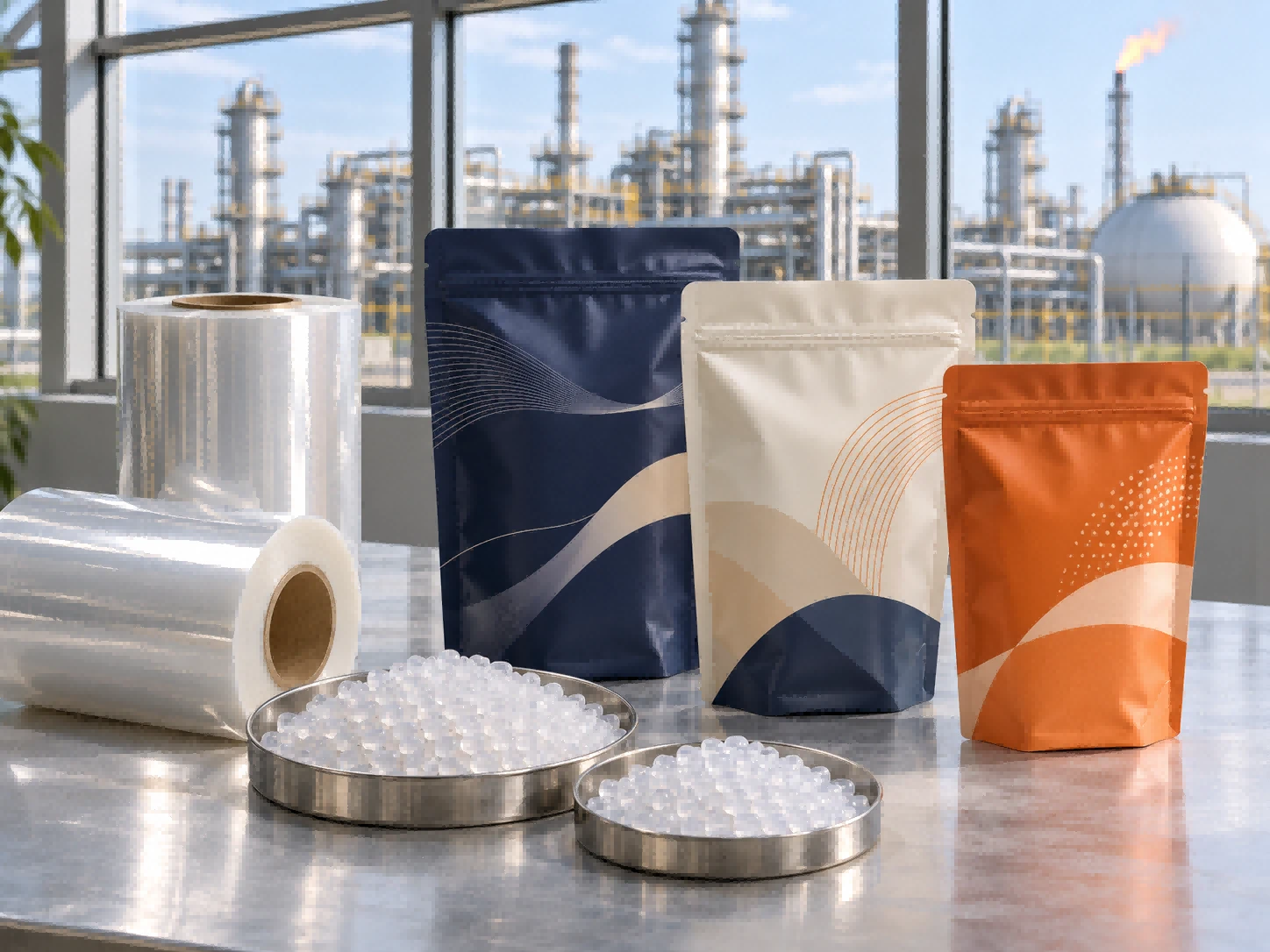
Crude oil influences packaging through petrochemical feedstocks, although the relationship varies by production route and region.
In naphtha-based production, changes in oil costs can affect ethylene and propylene economics, which influence polyethylene and polypropylene. However, inventory cycles, plant operating conditions and local supply can delay or weaken that transmission. polymerupdate.com
| Packaging material | Common flexible packaging use | What buyers should monitor |
|---|---|---|
| PE, including LDPE and LLDPE | Sealant layers, films and mono-PE pouches | Film-grade availability, sealing performance and supplier offers |
| PP, including converted BOPP and CPP films | Snack packaging, print layers and selected retort structures | Propylene trends, film conversion costs and grade suitability |
| PET film | Printed outer layers and laminated structures | Polyester feedstocks and film supplier pricing |
| Specialty barrier structures | Coffee, vacuum and high-barrier packaging | Individual layer costs, availability and qualification requirements |
A pouch also includes printing, adhesives, conversion, quality inspection and sometimes valves or spouts. Consequently, a 10% change in a resin benchmark does not automatically produce a 10% change in the finished packaging price.
Does the latest oil decline mean packaging will become cheaper?
It may ease pressure, but immediate savings are uncertain.
Reuters reported Brent at approximately $95.30 per barrel and WTI at $88.34 during early trading on November 16. The benchmarks had fallen 16% and 13%, respectively, during the previous week, as expectations shifted toward improving supply.

These were intraday readings, not closing prices.
The purchasing implication is to review quotations more frequently. Suppliers may need time to consume higher-cost inventory, while particular film grades can remain tight.
Compare equivalent structures and specifications across quotations. A cheaper offer achieved by reducing thickness or changing a barrier layer may increase leakage, product deterioration or filling-line problems. Packaging cost should be assessed against the quantity of saleable product it protects.
Are shipping rates from China to Europe and America falling?
The latest available benchmark showed weekly declines on several major routes.
Drewry's November 12 assessment recorded the following spot rates:
| Reference route | USD per 40-foot container | Weekly movement |
|---|---|---|
| Shanghai–Los Angeles | $7,416 | Down 2% |
| Shanghai–New York | $9,020 | Down 3% |
| Shanghai–Rotterdam | $3,504 | Down 3% |
| Shanghai–Genoa | $4,168 | Broadly unchanged |
Source: Drewry World Container Index, November 12, 2026. These are route benchmarks, not quotations for every Chinese export port or an all-inclusive delivered shipment. 12 Nov
For packaging sourced from Guangdong, buyers should obtain current Shenzhen or Guangzhou departure quotations. Compare the same container type, destination, sailing window and included charges.
Drewry also reported capacity management through cancelled sailings and announced increases in Asia–Europe freight charges and peak-season surcharges. A falling weekly index therefore does not guarantee that the next available booking will be cheaper or faster.
How can buyers reduce total landed packaging costs?
Start by separating the factory price from the delivered cost.
A useful purchasing calculation includes packaging, inland transport, ocean freight, insurance, destination handling, applicable duties and local delivery. Inventory carrying costs and emergency replenishment should also enter the decision.
For lightweight pouches, carton dimensions and loading efficiency deserve attention. Buyers can request a packing proposal showing pieces per carton, carton volume, pallet configuration and estimated container loading.
Where schedules permit, consolidating compatible orders can reduce fragmented shipments. However, delaying urgent packaging simply to fill a container may create a larger production or sales loss.
The objective is a dependable landed cost per usable pouch.

What is the packaging cost outlook for 2027?
The following scenarios are planning assumptions, not price forecasts.
| Scenario | Possible cost implications | Practical response |
|---|---|---|
| Energy and logistics stabilize | Reduced pressure on replacement materials and shipping | Purchase in stages and review quotes regularly |
| Supply disruptions return | Higher feedstock, insurance or transport costs | Protect essential demand and confirm alternative supply |
| Demand remains weak | Greater price competition, alongside possible production cuts | Negotiate carefully and verify delivery reliability |
Different costs may peak at different times. Businesses should therefore avoid basing an entire annual purchasing decision on one oil-price movement or freight index.
What could Shenzhen APEC mean for international packaging trade?
As of November 16, the Shenzhen meetings were still upcoming. China's Foreign Ministry announced the APEC Economic Leaders' Meeting for November 18–19 and the CEO Summit for November 17–18. Outcomes should therefore be assessed after the meetings rather than assumed in advance. fmprc.gov.cn

APEC's preparatory discussions provide useful signals. Senior officials have considered trade digitalization, regional integration, connectivity, electronic bills of lading and cooperation involving customs technology. APEC
For packaging exporters and importers, the potential value lies in easier documentation, more predictable transactions and stronger business communication if cooperation translates into implementation.
Diplomatic engagement could improve confidence, but buyers should not assume that a summit announcement will immediately change tariffs, resin prices or freight bookings. European customers should also assess their own trade and regulatory requirements separately.
How much packaging should companies buy in advance?
Advance planning is valuable; excessive inventory can tie up cash and leave outdated printed packaging.
A practical starting point is to separate confirmed demand, probable replenishment and speculative growth. Secure packaging for firm orders, then schedule additional purchases against updated sales forecasts.
Set the reorder point using expected consumption during the complete replenishment lead time, plus a safety allowance for demand and delivery variation. Include artwork approval, material purchasing, manufacturing, shipping and clearance.
For established designs, discuss scheduled production or staged deliveries. For new products, use smaller initial quantities until demand is clearer.
China-based custom flexible packaging manufacturers such as HongBang Packaging can be included in this planning process, with discussions focused on material specifications, production schedules and shipment consolidation.
Buyers cannot eliminate commodity or geopolitical risk. They can reduce exposure to uncontrolled purchasing costs by planning earlier, buying in measured stages and reviewing the full supply chain before shortages force an urgent order.