
Introduction: A Growing Global Coffee Market
The global coffee market continues to expand steadily, driven by rising consumption in emerging economies, premiumization in developed markets, and the rapid growth of specialty coffee brands. As consumer expectations evolve toward freshness, sustainability, and convenience, coffee packaging has become a strategic factor in product differentiation and brand positioning. For roasters, retailers, and private-label brands, selecting the right coffee packaging solution is no longer just about containment-it is about preservation, presentation, and performance.
In 2026, the coffee packaging industry is shaped by three dominant forces: extended shelf life requirements, sustainability compliance, and premium shelf appeal. Understanding these trends is essential for businesses seeking long-term competitiveness.
Key Coffee Product Categories and Packaging Requirements
Different coffee products demand different packaging structures due to variations in oxidation sensitivity, moisture tolerance, and degassing behavior.
1. Whole Bean Coffee Packaging
Freshly roasted coffee beans release carbon dioxide for days after roasting. Therefore, coffee bean packaging must include a one-way degassing valve to release gas while preventing oxygen ingress.
Common formats:
Flat Bottom Bag
Side Gusset Bag
Stand Up Pouch
Recommended structures:
PET / VMPET / PE
BOPP / Aluminum Foil / PE
High oxygen and moisture barrier properties are essential to preserve aroma and flavor.
The coffee industry includes roasted beans, ground coffee, instant coffee, capsules, and cold brew products, each with distinct packaging needs. Effective packaging must deliver strong light, oxygen, and moisture barriers to preserve aroma and freshness.
Coffee beans and grounds often require one-way degassing valves, while single-serve capsules demand convenience and tight sealing. Instant coffee needs lightweight, portable structures, and cold brew relies on leak-resistant packaging. Eco-friendly and customizable designs also meet modern consumer demands. Professional packaging ensures quality retention, shelf appeal, and compliance with global coffee market standards.
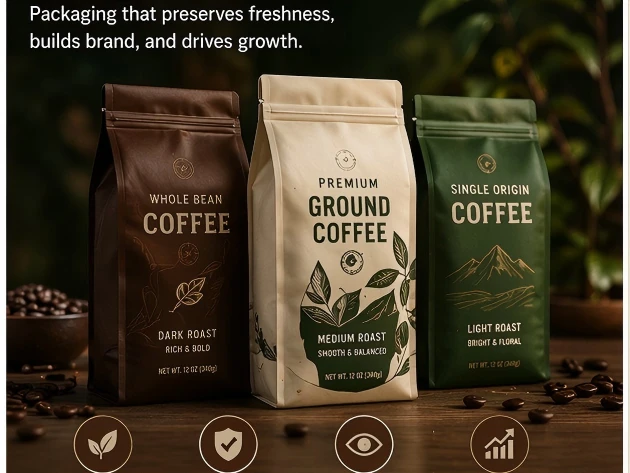
2. Ground Coffee Packaging
Ground coffee oxidizes more quickly than whole beans. This category requires high-barrier laminate structures and often benefits from zipper reclosure for consumer convenience.
Popular options:
Stand Up Pouch with zipper
Flat Bottom Bag
Vacuum-sealed bag
Barrier performance is prioritized over transparency in most premium markets.
3. Instant Coffee and Stick Packs
Instant coffee products emphasize portability and moisture resistance.
Packaging solutions:
Three-side seal bags
Stick packs (automatic filling roll film)
Packaging Roll Film for high-speed production
Moisture-proof laminated films are critical to prevent caking and flavor degradation.
4. Ready-to-Drink and Coffee Concentrates
Liquid coffee products require:
Spout Pouch (Liquid Bag)
Stand-up liquid packaging
These formats must ensure strong seal integrity, puncture resistance, and leak prevention.
Major Trends Shaping Coffee Packaging in 2026
1. Sustainability and Recyclability
Environmental regulations and consumer awareness are accelerating the shift toward:
Mono-material recyclable structures (Mono-PE, Mono-PP)
Reduced aluminum content
Compostable films (in niche markets)
Brands increasingly demand packaging that balances sustainability with barrier performance.
2. Premiumization and Shelf Impact
The rise of specialty coffee drives demand for:
Flat bottom bags with matte finishes
Soft-touch lamination
Spot UV and metallic effects
Custom printed high-definition graphics
Packaging has become an extension of brand storytelling.
3. E-Commerce Compatibility
Online coffee sales continue to grow. Packaging must withstand:
Compression during shipping
Long-distance logistics
Temperature fluctuations
Stronger seal strength and thicker material structures are increasingly required.

Material Innovation and Barrier Technology
High-barrier laminated structures remain essential for preserving coffee quality. Advanced lamination methods, including solvent-free lamination, improve food safety compliance while reducing environmental impact.
Key technical considerations include:
Oxygen Transmission Rate (OTR)
Moisture Vapor Transmission Rate (MVTR)
Seal strength consistency
Degassing valve reliability
Manufacturers investing in R&D and material science are better positioned to serve premium and export markets.
Market Outlook: Opportunities for Coffee Packaging Manufacturers
The coffee packaging industry will continue growing alongside specialty coffee expansion, private-label development, and sustainable packaging regulations. High-potential segments include:
Premium flat bottom coffee bags
Recyclable barrier pouches
Small-batch digital printed coffee packaging
Customized private-label packaging solutions
Companies that combine technical expertise, customization capability, and sustainable innovation will capture greater market share.
Conclusion
In 2026 and beyond, coffee packaging is no longer a simple protective layer-it is a critical competitive asset. From degassing valve coffee bags to recyclable high-barrier laminates, the industry is evolving toward higher performance, stronger branding, and greener materials.
For coffee brands seeking growth, investing in advanced packaging solutions ensures not only product freshness but also stronger consumer trust and market positioning.