

The European Union's Packaging and Packaging Waste Regulation (PPWR) began applying on August 12, 2026, introducing important changes for businesses placing packaging on the EU market.
Meanwhile, PACK EXPO International 2026 in Chicago brought together packaging professionals to explore sustainable materials, automation, and production efficiency.
HongBang Packaging, a China-based custom flexible packaging manufacturer established in 1999, participated in the Chicago exhibition and is preparing to exhibit at Global Packaging Expo (GPE Guangzhou), November 5–7, 2026.
What do these developments mean for international packaging buyers?
1. Why Is Sustainable Packaging Becoming a Global Priority?
Growing packaging consumption has created challenges involving waste collection, recycling, material efficiency, and environmental impact.
According to Eurostat, the European Union generated approximately 79.7 million tonnes of packaging waste in 2023, equivalent to 177.8 kilograms per inhabitant.
Plastic represented approximately 19.8% of total EU packaging waste.
Although recycling infrastructure continues to develop, businesses face growing expectations to improve packaging design and reduce unnecessary material use.
Table 1. European Union Packaging Waste Data
| Industry Indicator | Reported Value |
|---|---|
| Total EU packaging waste, 2023 | 79.7 million tonnes |
| Packaging waste per inhabitant | 177.8 kg |
| Paper and cardboard share | 40.4% |
| Plastic packaging share | 19.8% |
| Glass packaging share | 18.8% |
| Plastic packaging recycling rate | 42.1% |
Source: Eurostat, EU packaging waste statistics for 2023, published in 2025.
These figures explain why recyclable packaging design, responsible material sourcing, and waste reduction are becoming important procurement considerations.
For international brands, the challenge is to improve environmental performance without compromising product quality or safety.
2. What Does the EU PPWR Mean for Packaging Buyers?
Q: When did the EU PPWR start applying?
A: Regulation (EU) 2025/40 generally began applying on August 12, 2026.
It establishes requirements relating to packaging design, materials, waste prevention, recyclability, and other areas across the EU market.
However, different provisions have different implementation dates.
Q: Does every package need to meet all future recycling requirements immediately?
A: No. The regulation includes phased requirements.
One major objective is to make packaging placed on the EU market recyclable in an economically viable way by 2030.
Businesses should review the timelines relevant to their specific packaging types.
Q: What about food-contact packaging?
A: The PPWR introduces restrictions on certain substances, including specified PFAS limits for food-contact packaging.
Compliance also depends on applicable food-contact material legislation and the packaging's intended use.
Buyers should request appropriate declarations and supporting test documentation.
Q: Does using recyclable material automatically guarantee compliance?
A: No. Material composition, packaging design, additives, barriers, labeling, and applicable legal requirements all matter.
A claim of recyclability should be supported by an appropriate technical assessment.
3. Why Are Mono-Material Packaging Solutions Receiving Attention?
Traditional high-barrier flexible packaging may contain combinations of PET, aluminum foil, nylon, polyethylene, or other materials.
These structures can provide excellent product protection, but separating different layers for recycling may be difficult.
Mono-material packaging aims to simplify material composition while maintaining necessary performance.
Q: What is Mono-PE packaging?
A: Mono-PE refers to packaging designed predominantly around polyethylene-based materials.
Depending on its structure, PE-based packaging may be suitable for certain dry food, refill, and liquid applications.
Q: What are recyclable Double-PE pouches?
A: Double-PE packaging generally uses PE-based film layers designed to provide the required sealing and functional properties.
It can be considered for selected liquid and refill packaging applications.
However, the product's actual recyclability depends on its full construction and the relevant collection and recycling systems.
Q: Can Mono-PE replace all conventional high-barrier packaging?
A: Not necessarily.
Some products require exceptional oxygen, moisture, light, chemical, or thermal resistance.
A technically suitable recyclable solution must balance environmental objectives with product protection and operational performance.
4. Which Sustainable Packaging Materials Should Buyers Consider?
Different product categories require different packaging approaches.
Table 2. Sustainable Packaging Options and Applications
| Material Solution | Potential Advantages | Suitable Applications |
|---|---|---|
| Mono-PE Pouches | Simplified PE-based structure | Snacks, powders, selected refills |
| Double-PE Liquid Pouches | PE-based liquid packaging construction | Selected beverages and refills |
| Mono-PP Packaging | Potential mono-polymer solution | Certain food packaging applications |
| PCR-Content Packaging | Uses post-consumer recycled material | Eligible non-food or validated uses |
| Kraft Paper Packaging | Paper appearance and branding appeal | Dry foods and lightweight products |
| Compostable Packaging | Designed for specified composting conditions | Selected applications with suitable disposal systems |
| High-Barrier Laminates | Strong product protection | Coffee, sensitive foods, ready meals |
These options should not be treated as interchangeable.
Compostable does not necessarily mean recyclable. Likewise, kraft paper packaging containing plastic or other barrier layers is not automatically biodegradable.
Packaging buyers should assess each material's technical characteristics and verified end-of-life claims.
5. How Can Sustainable Packaging Help Reduce Food Waste?
Environmental performance is not limited to what happens after consumers discard a package.
Packaging also helps protect food from contamination, moisture, oxygen, and handling damage.
According to the United Nations Environment Programme's Food Waste Index Report 2024, approximately 1.05 billion tonnes of food were wasted globally in 2022 at household, food-service, and retail levels.
This highlights the importance of effective product protection.
Q: Is using less packaging material always better?
A: Not always.
Reducing packaging weight may lower material consumption, but insufficient protection can contribute to product damage or spoilage.
Q: Can high-barrier packaging still play an important sustainability role?
A: Yes. For products with demanding shelf-life requirements, effective barrier protection can help reduce spoilage risk.
The best environmental choice requires an evaluation of packaging materials, food preservation, distribution, and end-of-life management.
For example, coffee beans, oily snacks, and moisture-sensitive powders may require different solutions from fresh produce or household detergents.
6. How Should Brands Evaluate Sustainable Packaging Suppliers?
Q: What should buyers request from a manufacturer?
A: Buyers should ask for a clear material specification, relevant compliance documentation, sample testing, and a technically justified sustainability claim.
For recyclable packaging, the complete structure should be evaluated, including barriers, inks, adhesives, closures, and other components.
Q: Is certification important?
A: Independent verification can help support material, manufacturing, and sustainability claims.
However, certificates have different purposes. A quality-management certificate does not automatically demonstrate recyclability or food-contact compliance.
Q: How can brands avoid greenwashing?
A: Use precise language supported by evidence.
For example, "PE-based packaging designed for recyclability" may be more appropriate than claiming a package is universally recyclable without validation.
Buyers should also review recycling infrastructure in the destination market.
7. What Solutions Does HongBang Packaging Offer?
HongBang Packaging provides OEM/ODM flexible packaging manufacturing, with material and design options selected according to product requirements.
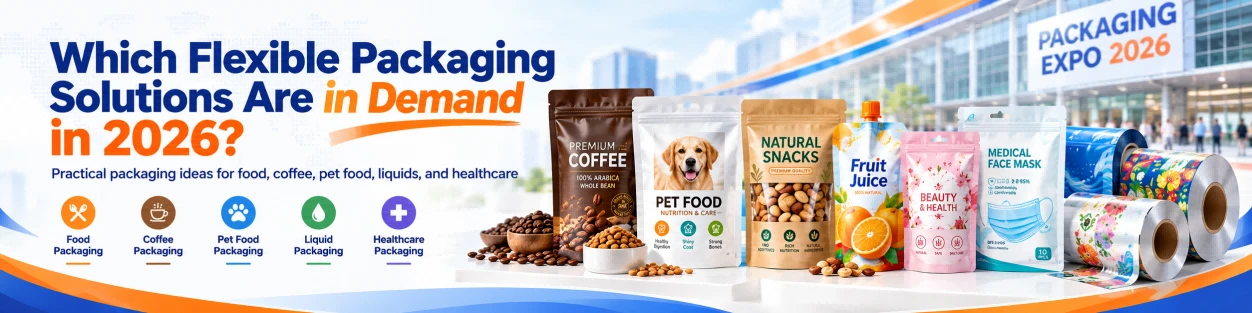
Its solutions include custom stand-up pouches, flat-bottom bags, coffee packaging, liquid spout pouches, pet food bags, packaging roll film, and high-barrier packaging.
For businesses exploring more sustainable alternatives, HongBang Packaging can discuss PE-based recyclable structures, selected paper-based packaging designs, and customized film options.
Customers can also request support with printing specifications, sample development, closure design, and material selection.
The company operates manufacturing and quality-control processes covering printing, lamination, curing, slitting, bag making, and inspection.
The recommended approach is to confirm performance requirements first, then evaluate suitable material alternatives.
8. What Did PACK EXPO 2026 Highlight About Packaging Innovation?
PACK EXPO International 2026 took place in Chicago from October 18–21.
The exhibition featured more than 2,700 exhibitors and covered automation, advanced packaging systems, sustainable materials, and other manufacturing technologies.
HongBang Packaging participated at Booth LL-10713.
These industry discussions reflect a broader challenge: packaging suppliers must support efficiency, product protection, and evolving environmental requirements simultaneously.
For buyers, this means technical expertise and documentation are becoming increasingly valuable supplier-selection criteria.
9. Where Can Buyers Explore Packaging Solutions Next?
HongBang Packaging will exhibit at Global Packaging Expo 2026 (GPE Guangzhou), offering another opportunity for manufacturers, importers, distributors, and brand owners to explore packaging solutions.
Exhibition Details
Date: November 5–7, 2026
Venue: Poly World Trade Center Expo, Guangzhou, China
HongBang Packaging Booth: B152
Visitors are welcome to discuss custom printing, recyclable PE-based packaging, liquid packaging, food pouches, coffee bags, and other flexible packaging applications.
The exhibition provides an opportunity to compare packaging formats and discuss suitable solutions for international markets.
10. What Should Global Brands Do Before 2027?
Businesses planning packaging procurement should begin by reviewing existing packaging structures and identifying products suitable for redesign.
Key considerations include material specifications, legal requirements, supplier capabilities, recycling systems, and commercial feasibility.
Working with a packaging manufacturer early in product development can make it easier to evaluate alternative films, test packaging performance, and coordinate production requirements.
For wholesalers and distributors, supplying multiple material options with reliable technical information may become an increasingly important competitive advantage.